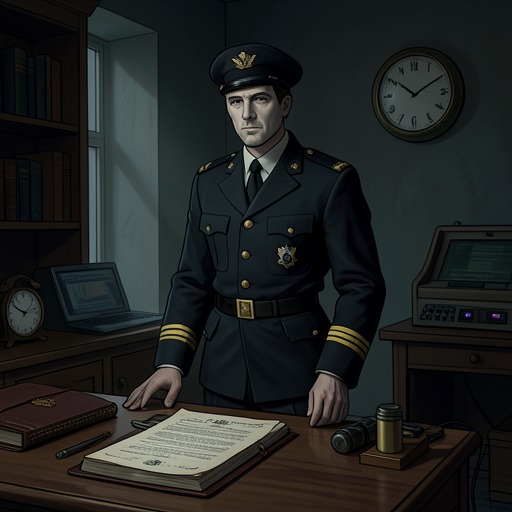
Maryk's fleet fitness reports
The Caine Mutiny Court-MartialMaryk's fleet fitness reports are two assessments of Steve Maryk that Captain Queeg wrote six months apart. At Maryk's court-martial, Greenwald produced authenticated photostats of the reports and used their consistently high praise to test Queeg's account of Maryk's performance against Queeg's own written evaluations. The documents make the captain's changing testimony concrete: even after a succession of difficult operations and shipboard conflicts, his July assessment described Maryk as outstanding and qualified for command.
The Reports as Trial Exhibits
Greenwald introduced two glossy black photostats from his folder, identified them as authenticated copies of Queeg's fitness reports on Maryk, and asked Queeg to read the relevant comments. Their force in court came not only from what they said but from who had written them: Queeg had to confront his own official assessments while under questioning about Maryk's conduct and fitness.
The reports also gave Greenwald a way to shift the examination from recollection to a fixed record. Queeg had offered a narrative in which Maryk began brilliantly and later cooled off; Greenwald asked him to read the written evaluations rather than repeat that characterization. The papers therefore served as a direct comparison between Queeg's oral account and his formal judgments.
January 1944 Assessment
Greenwald first asked Queeg to read his January 1944 comment. Queeg initially tried to restate his characterization of Maryk instead of reading the report, but Greenwald insisted on the document. Queeg then read a highly laudatory description in a choked voice. The January assessment thus established that Queeg's own written record praised Maryk, in contrast to the decline Queeg had just described in court.
The report's timing matters to the examination: it supplies an earlier benchmark against which Greenwald can set the later evaluation. Rather than asking the court to rely only on competing recollections, the defense could point to a sequence of official assessments authored by the witness himself.
July Assessment and Its Context
Greenwald next fixed the timing of the July report. By then, the USS Caine had been through the Kwajalein and Saipan invasions, as well as the water shortage, coffee investigation, Stilwell court-martial, and suspension of movies. Queeg hesitated before acknowledging that these incidents had already occurred. The chronology made the July evaluation especially consequential: it was written after, not before, the strains and controversies Greenwald listed.
Queeg read the July 1 comment, which said Maryk had improved, and described him as consistently loyal, thorough, courageous, and efficient. It judged him “fully qualified for command of a 1200-ton DMS,” called his professional zeal and integrity outstanding, and recommended him for transfer to the regular Navy. The report's emphatic approval directly undercut any simple claim that Maryk's performance had deteriorated by the summer.
Evidentiary Force and Limits
The two reports turn Queeg's own paperwork into a challenge to his credibility. Their praise does not by itself establish everything about Maryk's actions or settle the court-martial; it does show that Queeg had formally assessed him very favorably in January and again on July 1, after the incidents raised in court. The contrast leaves the witness answerable to a record that his testimony cannot easily reconcile with a narrative of sustained decline.
After Queeg finished reading the July comment, Greenwald ended his questioning. Challee, the opposing counsel, approached the witness stand but declined to cross-examine him. The reports thus remain the final documentary test of Queeg in this exchange: his own written words, rather than another round of argument, close the examination.